-
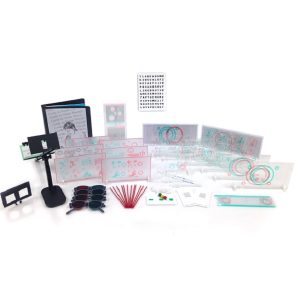 Provides a large selection of products useful in testing and training the most common vision training problems. Includes accommodative difficulties, poor fusional ranges, high phorias, exercises for strabismics, unresponsive & difficult to test patients. Red/Green slides or targets are used with Red/Green glasses providing Base-In, Base-Out training, Tranaglyph slides offer true space testing & training for heterophorias and low fusional ranges.
 -
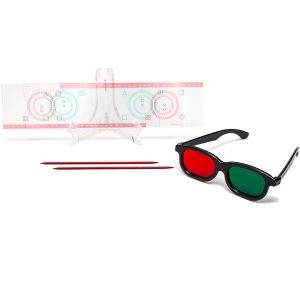 The new BC930 is a variation of our popular 920 and 925 instruments. The new feature of the BC930 slide is the ability to do jump ductions with a wide range of base in and base out options. Either side of the 930 slide can be set to various base-in or base-out values. With this inexpensive device, you can set it to two difference base-in demands or two base-out demands or one side base-in and one base-out and "jump" back and forth between the two images. Since it has its own holder, the card may easily be held in the primary position of gaze, to either side, or superior or inferior. This is very valuable for sports vision with we want to train a volleyball player's upward gaze; a hockey player's inferior gaze or to either side. Consider using a second BC930 to "jump" between 2 instruments; each one set with two different demands, for a total of 4 variable images in two positions.
 -
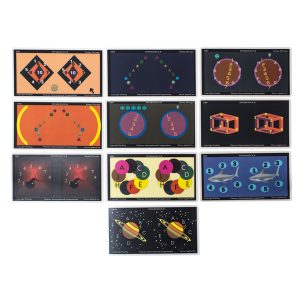 Morgenstern Color Fusion Cards - Divergence B Used with Bernell-O-Scope™ Builds large ranges of vergence (pull all the way in and out). Work in and out of instrument. Hold in space and fuse, diverge, move fused targets and also converge some. Made for "tromboning" work in the stereoscope as well as "pointing". Each card features eclectic designs and unique arrangements. Item #: SMDB
 -
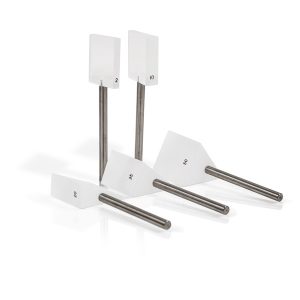 Any of the square prisms are now available with a stainless steel holder. Easier to hold and keep finger oils off prisms. Less chance to break than acrylic holders sold by others. Allow quick alternations of BI-BO or BU-BD at distance or near. Item #: ASPS+
 -
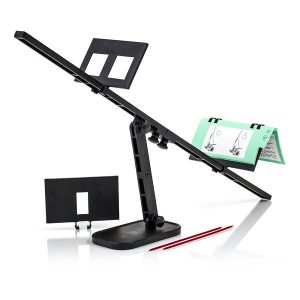 The Bernell Aperture Rule™ Trainer Kit (BLACK) A standard instrument in most VT programs. Features progressive fixed demand. Polarized or colored lenses are not required. Helps improve low fusional and accommodative reserves, poor stereopsis, fixation disparity suppression & tight accommodation-conversion relationship. The trainer assists patients with asthenopia & visually related learning problems. 30PD Base-Out to 17.5PD Base-In. Item #: BC1050BK
 -
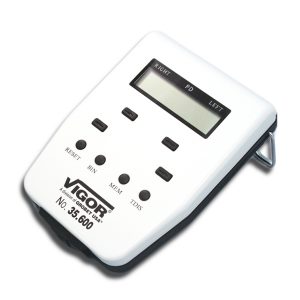 Look more modern while improving your accuracy and decreasing remakes with your PAL's. This digital pupilometer is easy to use. Requires 4 AA batteries (not included).
 -
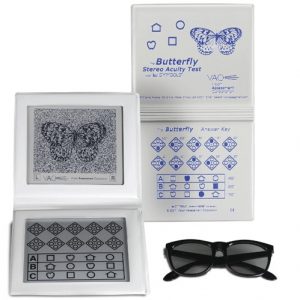 Butterfly Acuity Test with Lea SYMBOLS® Test designed to rapidly test for amblyopia & strabismus using gross thru fine stereopsis (4800 to 20 sec of arc) - Graded Circle Test from 800 sec now down to 20 sec - No monocular clues - New improved booklets - Answer Key on back cover - Includes polarized viewers
 -
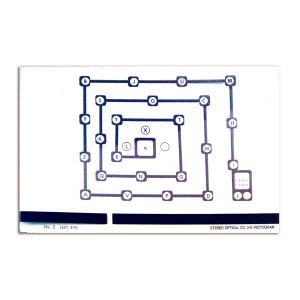 Variable Vectogram Baseball Vectogram Polarized vectograms ensure testing and training at actual distances. Vectograms stabilize fusion and steropsis, eliminate suppression and develop simultaneous vision. Used in monocular, binocular pursuit and saccadic training, vectograms help correct and prevent anomalies involving projection and hand-eye coordination. Ideal for use with Bernell's Dual Polachrome™ Trainer
 -
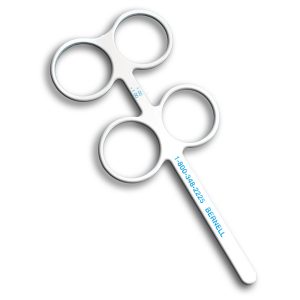 Test and train for accommodative facility, accommodative rock, positive/negative relative accommodation and convergence and fusional convergence reserves. May delay bifocal use with some early presbyopes. Assists in hyperopia screening and lens demonstrations. Durable, white plastic holds shape under low heat for lens insertion. Powers listed on handle. One pair plus; one pair minus. Select from +/- 0.25 to 4.00 diopters in 0.25 increments. Item #: BC1270+
 -
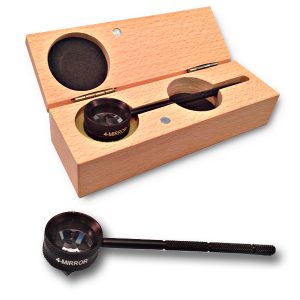 This 4 mirror glass lens is used for viewing all quadrants of the anterior chamber without lens repositioning. Mirrors are placed at angles of 62 degrees. No flange. No fluid required. Removable handle screws into place. Lens diameter: 20mm Rim Diameter: 25mm Lens Contact Point: 9mm Comes with padded case Item #: AMPDSG
 -
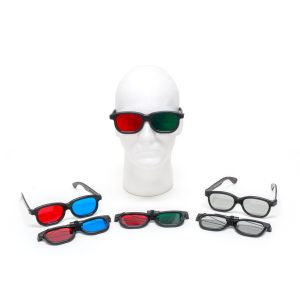 This new design offers a similar size frame as our Bernell Original Model, but with rounded edges for a more comfortable feel. These goggles come with temples or elastic strap. The goggles are available in packages of 6 or individually.Item #: BC1189+
 -
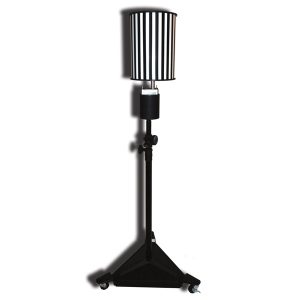 We now sell an optokinetic drum that has the same DC motor and control box as our Stand Rotator (BC1060). The OKN drum can rotate through a wide range of speeds but especially a wide range of very slow ratation and can reverse. See also the DAL300WR with a digital display of speeds. Unit is on wheels so that it can be more easily stored. Item #: DAL300W
+65 6514 0848|info@ophthalmic.com.sg